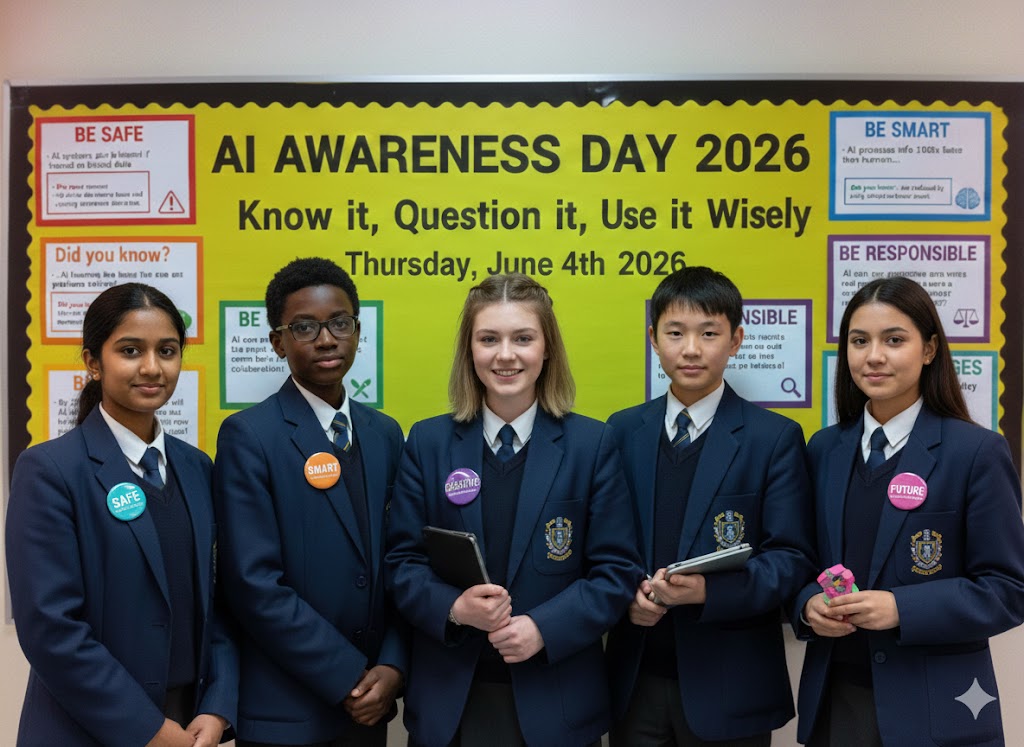
Thursday 4th June 2026
Know it, Question it, Use it Wisely
A nationwide day for schools, students, and parents to explore AI together.
Help shape AI Awareness Day 2027
Whether you took part in AI Awareness Day or not, we want to hear from the educators, school leaders, and computing specialists who made 4 June 2026 such a historic day — and from those who didn’t quite make it this year. Whether you ran a whole-school assembly or never heard about us until now, tell us what worked, what got in the way, and what you need from us to make 2027 even bigger.
What is AI Awareness Day?
National AI Awareness Day (4th June 2026) is a new nationwide campaign designed to build AI literacy across UK schools. The model is simple: schools commit to running just one activity.
Our goal is to create a unified moment where the entire education community comes together to engage positively and critically with AI — preparing the next generation for a world increasingly shaped by intelligent technology.
1,000,000 reach so far
The support for AI Awareness Day is growing fast. With the help of our partners — charities, edtech organisations, multi-academy trusts, a national broadcaster, and a multinational publishing and education company — sharing the campaign via social media, newsletters and more, we estimate we're already reaching over 1,000,000 students. Together, we're building a national movement.

28,000 students annually
AI resources ↗
115,000 primary teachers have accessed Barefoot
AI resources ↗
AI resources ↗
AI resources ↗
Nationwide Network of Computing Educators
AI resources ↗
Over 6.5 million young people have been reached through NCCE-supported programmes.
AI resources ↗
Works with over 19,000 schools, every local authority in the country
AI resources ↗
AI resources ↗
AI resources ↗
AI resources ↗
Computing CPD and resources for teachers and leaders
AI resources ↗
Supports approximately 270,000 teachers annually
AI resources ↗
295,000 children directly reached in UK Classrooms
AI resources ↗
Over 250 UK schools, colleges, and Multi-Academy Trusts (MATs) have entered the certification pipeline
The world’s biggest education technology event
Black and Global Majority-led community initiatives and the room where AI policy, regulation, and power are shaped.
36 schools across Surrey, Hampshire and South London.
London's largest Further Education college 32,000 students
400 businesses in Central London
20 schools across Bedfordshire and Luton
38 academies, 25,000 students
Alternative Provision Free School (Academy)
50 schools, 33,000 students
15,000+ tech leaders
20,000 tech professionals
Transformational Youth Entrepreneurship For All
Digital strategy and delivery consultancy
Join the campaign
Complete form to join movement
What’s On?
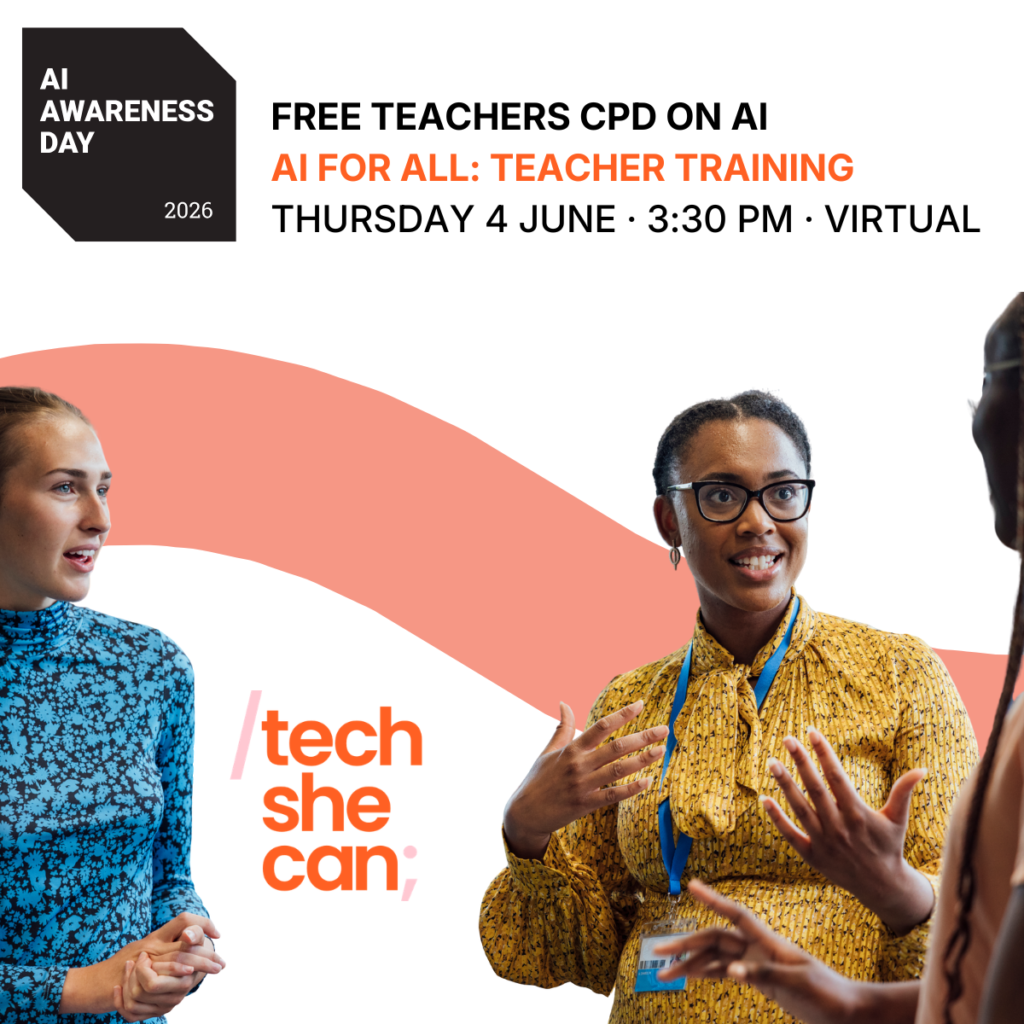
Upcoming events, conferences, CPD, courses and live online sessions for schools and educators.
-
Friday 26 June 2026
09:00 – 16:00
The STEM Digital Conference
STEM Learning
Campaign Updates
As we celebrate EdTech Week, it seems fitting to place one of the sector’s most ambitious innovations firmly under the spotlight: AI tutors.
Over the past year, governments, technology companies, investors and educational startups have collectively accelerated the development of generative AI systems designed to support teaching and learning. From personalised revision assistants and conversational homework helpers to sophisticated tutoring platforms capable of adapting to individual learning styles, artificial intelligence is increasingly being presented as the future of education.
Supporters believe AI tutors could revolutionise learning by providing personalised support at a scale that human systems simply cannot match. Advocates point to their ability to offer instant feedback, unlimited patience, round-the-clock availability and highly tailored learning pathways.
The UK Government has embraced this vision. Through its AI Tutoring Tools Pioneers Programme, ministers hope that artificial intelligence can help tackle persistent attainment gaps while providing additional support to hundreds of thousands of disadvantaged pupils.
Yet history teaches us that educational technology should always be examined with caution.
For decades, each new wave of innovation has arrived with similar promises. Educational television was supposed to democratise learning. Personal computers were expected to transform classrooms. The internet promised universal access to knowledge. MOOCs claimed they would open elite education to everyone.
Each innovation delivered genuine benefits. None fundamentally eliminated educational inequality.
This raises an important question. Are AI tutors genuinely different, or are they simply the latest technological solution being applied to a problem that is ultimately social, economic and political in nature?
To understand why this digital pivot is so contentious, one must first look at the unprecedented scale of the British tuition boom.
The 20-Year Tutoring Explosion
Over the past two decades, private tutoring in England and Wales has transitioned from a discreet luxury for the wealthy into an essential mainstream standard.
Tracking data from the Sutton Trust reveals a massive upward curve:
- 2005: Only 18% of secondary school students had ever received private tutoring.
- 2014: The figure crept up to 23% as parents began aggressively prepping children for grammar school entries.
- 2019: It reached 27%, driven by a massive “London Effect.”
- 2026: Private tutoring has hit its highest record ever at 29% nationally, escalating to 45% in London.
As standard schooling faces continuous budget and staffing pressure, commercial after-school franchises focusing on Maths, numeracy, and digital literacy such as Kumon and Explore Learning have absolutely rocketed across high streets. Tutoring is no longer an occasional intervention; it is an ongoing, decentralised fixture of modern family life.
The First-Generation Defiance
Crucially, this expansion shatters traditional socioeconomic stereotypes. Private tutoring in the United Kingdom has become a fundamentally minority-driven phenomenon [Sutton Trust 2026 Private Tutoring Report]:
- 64% of Black students have received private tutoring.
- 50% of Asian students have received private tutoring.
- 20% of White students have received private tutoring.
Even in the country’s most economically deprived neighbourhoods, 65% of disadvantaged Black pupils and 43% of disadvantaged Asian pupils use private tutors. This compares with a mere 10% of their white peers.
Tutoring Rates in the UK's Most Deprived Areas:
======================================================
[████████████████████████████████████] 65% Black Pupils
[████████████████████████] 43% Asian Pupils
[████] 10% White Pupils
======================================================
This is the “Immigrant Paradigm” in action. For first-generation families, education is the single guaranteed vehicle for social mobility. These families treat tutoring fees like a utility bill cutting back on holidays, new clothes, and groceries to ensure a human practitioner is paid to help their children navigate selective grammar school entries and crack the code of the state curriculum. They refuse to trust their children’s future to a passive screen.
The EdTech Superpower (and the Wall it Hits)
Ambitious households have never resisted educational technology. In fact, they have often been its earliest adopters.
Long before ChatGPT and generative AI entered classrooms, schools were already experimenting with personalised digital learning. The roots of modern EdTech stretch back much further than many people realise. During the 1980s and 1990s, educational software became a fixture of school computer suites and family homes. Programmes such as Encarta transformed how students accessed information by offering searchable multimedia encyclopedias years before Wikipedia existed. Educational titles from publishers such as Dorling Kindersley, The Learning Company and Broderbund combined text, images, animations and quizzes to make learning more interactive. Schools also embraced early computer-assisted learning packages for mathematics, literacy and science, while CD-ROMs promised vast libraries of educational content at students’ fingertips.
Remember systems such as SuccessMaker, which were already attempting to personalise learning decades before artificial intelligence became a mainstream topic. SuccessMaker assessed reading and numeracy ability, adapted activities to individual learners and tracked progress over time. For many pupils, it was their first experience of software that appeared to understand where they were struggling and adjust accordingly.
The following decade saw the rise of Virtual Learning Environments such as Fronter, Moodle and Blackboard. These systems promised to transform education by allowing students to access learning materials online, submit assignments electronically, receive feedback remotely and store their work digitally. For schools at the time, this felt revolutionary. Students could access resources beyond the classroom, teachers could monitor progress more effectively and learning materials became available anytime and anywhere.
Looking back, many of the ambitions driving today’s AI revolution were already present in these earlier generations of educational technology. Personalised learning, instant access to knowledge, interactive exploration, online assessment, digital portfolios and self-directed study have been recurring themes throughout the history of EdTech.
Many of the concepts being presented as revolutionary today are therefore not entirely new:
- Adaptive learning pathways.
- Online assessment and feedback.
- Personalised learning journeys.
- Learning analytics and progress tracking.
- Cloud-based storage of student work.
- Anytime, anywhere access to educational content.
What generative AI introduces is something genuinely different: Conversation
Rather than clicking through pre-programmed exercises or answering multiple-choice questions, students can now engage in dynamic dialogue. Modern AI tutors can act as real-time learning companions, guiding students through problems using hints, questions and tailored explanations rather than simply delivering answers. This shift from clicking to conversing represents one of the most significant developments in educational technology for decades.
Supporters argue that this creates several important advantages.
First, AI tutors can provide a psychologically safer environment for learning. Many students are reluctant to admit confusion in front of teachers, peers or parents. A conversational AI allows learners to make mistakes privately, ask the same question repeatedly and explore uncertainty without fear of embarrassment. For students experiencing academic anxiety, this can create a valuable space for experimentation and confidence-building.
Second, AI tutors offer unprecedented scalability. Unlike human tutors, they are available twenty-four hours a day, can support unlimited numbers of learners simultaneously and provide immediate feedback regardless of location or socioeconomic circumstances. For pupils who would otherwise receive no additional support, this accessibility could prove transformative.
Third, they have the potential to support a diverse range of learners. Adaptive explanations, multilingual capabilities and personalised pacing may prove particularly useful for neurodivergent students, English-language learners and pupils who require additional reinforcement outside the classroom. Features such as automated feedback, progress dashboards and gamified learning pathways can help tailor educational experiences to individual needs.
Supporters also argue that AI systems can reduce some of the barriers that students encounter in traditional educational settings. Unlike humans, software does not consciously judge a student’s accent, appearance, ethnicity or background. While algorithms themselves are not free from bias, many advocates believe AI can create a more neutral and accessible learning environment for some learners.
These are genuine strengths, and they help explain why ambitious families have been quick to embrace AI-powered learning tools alongside more traditional forms of educational support.
Yet history suggests we should also be cautious. Every generation of educational technology has promised to democratise learning. Educational television, personal computers, virtual learning environments, tablets and MOOCs all arrived with claims that they would fundamentally transform educational outcomes. Most delivered valuable improvements. But none replaced the importance of human relationships. This is what might be called the adoption wall.
No matter how sophisticated the technology becomes, learners eventually encounter the realities of human behaviour. Screen fatigue emerges. Motivation declines. Distractions multiply. Engagement weakens. Without accountability and human encouragement, many students simply stop participating.
The experience of Massive Open Online Courses provides a powerful example. Despite attracting millions of learners worldwide, completion rates often hovered between 5% and 10%. Access to world-class content was not enough. Many learners still required structure, encouragement and personal accountability to persist.
The same challenge may confront AI tutors.
Technology can deliver information, feedback and personalised guidance. What remains less certain is whether it can replicate trust, mentorship, motivation and belief.
Ambitious families understand this distinction. That is why they have historically embraced educational technology while continuing to invest heavily in human tutors. They see technology as a powerful supplement, not a complete substitute. They recognise the benefits of digital tools, but they also understand that educational success is often driven by relationships, accountability and encouragement. The lesson from more than thirty years of EdTech is therefore surprisingly consistent. Technology changes how learning is delivered. Human relationships still determine whether learning sticks.

The Digital Divide: Premium Humans vs. State Automation
As families continue to stretch household budgets to secure additional educational support, a critical question emerges: Does AI supplement human tutoring, or does it accelerate the formation of a two-tier educational system in which access to human mentorship increasingly becomes a privilege of wealth?
Evidence suggests that affluent households are not abandoning human tutors in favour of automation. Instead, they are using technology to expand access to human expertise. The rapid growth of online tutoring demonstrates this shift: 71% of tutored pupils now receive support remotely rather than face-to-face, allowing families to access specialist tutors regardless of location (Sutton Trust, 2026).
Technology, in this context, functions primarily as a delivery mechanism. The core value proposition remains the same: personalised attention, mentorship, accountability, emotional intelligence, and adaptive pedagogical judgement. These qualities continue to command a premium and remain concentrated among families able to purchase them.

Rather than replacing human practitioners, AI may therefore reinforce the market value of human educational relationships. As automated learning tools become ubiquitous, authentic human guidance may become an increasingly scarce and valuable educational resource.
The picture is markedly different within the state sector. Following the end of large-scale funding for the human-led National Tutoring Programme, 58% of state schools reported reducing their tutoring provision (Sutton Trust, 2026). Into this gap, the government has introduced the AI Tutoring Tools Pioneers Programme, aiming to provide AI-supported tutoring tools to as many as 450,000 disadvantaged pupils across England.
The policy has generated significant concern. Education unions report that 66% of teachers have received no formal school guidance on AI use, leaving schools to manage issues such as AI-assisted plagiarism and assessment integrity independently (NEU, 2026). Critics, including Shadow Education Secretary Laura Trott, have argued that disadvantaged pupils risk becoming test subjects in an educational experiment whose long-term effects remain uncertain.
This debate exposes a broader contradiction. Policymakers have increasingly expressed concern about unrestricted adolescent access to digital platforms and conversational AI systems, while simultaneously promoting AI-mediated learning within state education. The result is an unresolved tension between caution and deployment.

More fundamentally, government procurement documents reveal that the Department for Science, Innovation and Technology itself acknowledges significant limitations in the current market. Official tender documents note that existing AI tutoring products remain limited in scope, capability, and supporting evidence, with relatively few providing comprehensive tutoring functionality.
The central question, therefore, is not whether AI can support learning. It is whether AI is being deployed as an educational enhancement or as a substitute for human provision that governments are no longer willing or able to fund. If affluent families continue to purchase human mentorship while disadvantaged pupils increasingly receive automated alternatives, AI may not reduce educational inequality. Instead, it may institutionalise a new divide in which human attention itself becomes the scarce educational resource.
The Invisible Invoice: Marketing, Ethics, and the Ecological Cost of AI Tutoring
Beneath the promises of personalised learning and educational transformation lies a more uncomfortable question: who pays the hidden costs of AI tutoring?
The dominant narrative surrounding educational AI presents these systems as inevitable technological progress efficient, scalable, and capable of democratising access to learning. Yet this framing often obscures a broader political economy in which governments, technology firms, and investors all possess strong incentives to promote AI adoption. For policymakers facing budgetary pressures, AI offers the promise of doing more with less. For technology companies, education represents one of the world’s largest untapped markets. For investors, continued expansion into schools helps justify the enormous valuations underpinning the contemporary AI sector. The result is a powerful convergence of interests that risks portraying AI tutoring not simply as an educational innovation, but as a solution whose benefits are amplified while its costs remain largely invisible.
Every interaction with an AI tutor depends upon a vast physical infrastructure of data centres, semiconductor manufacturing, electricity generation, and cooling systems. While AI is often presented as an intangible digital service, its environmental footprint is anything but virtual. The International Energy Agency projects a dramatic increase in electricity demand from AI-related data centres over the coming decade as governments and technology firms accelerate deployment. At the same time, researchers have raised concerns about the enormous volumes of freshwater required to cool increasingly powerful computing infrastructure, particularly in regions already facing water stress. The extraction of rare earth minerals and other critical materials required for advanced hardware further extends the environmental burden beyond the classroom and into global supply chains. This creates an uncomfortable paradox: technologies marketed as tools for educational advancement may simultaneously contribute to ecological pressures that future generations will inherit.

Equally significant are concerns surrounding children’s data rights. AI tutoring systems do not simply deliver information; they generate and collect extensive behavioural data about how students learn, what they struggle with, how quickly they respond, what questions they ask, and which interventions appear most effective. In theory, such information can be used to personalise learning. In practice, questions remain about ownership, transparency, retention, commercial use, and long-term accountability. Unlike traditional educational resources, AI systems can continuously learn from interactions, creating uncertainty about how student data contributes to the ongoing development of proprietary models. Children therefore occupy a uniquely vulnerable position within the AI ecosystem. They are simultaneously the intended beneficiaries of these technologies and the source of the behavioural data that helps improve them.

The ethical challenge is not whether AI can support learning. Increasingly, evidence suggests that it can. The more difficult question is whether societies have adequately debated the trade-offs involved in deploying AI at scale within education. If AI tutors become a permanent feature of schooling, policymakers must grapple with questions that extend far beyond attainment scores. Who benefits financially from the data generated by students? Who bears responsibility when systems fail? How much environmental cost is acceptable in exchange for educational gains? And perhaps most importantly, should children’s education become a proving ground for technologies whose long-term social consequences remain uncertain?
These questions do not invalidate the potential benefits of AI tutoring. They do, however, reveal the existence of an invisible invoice—one that is frequently absent from discussions focused on efficiency, innovation, and scale. As with previous technological revolutions, the greatest costs may not be those visible at the point of adoption, but those that emerge years later, borne not by the companies promoting the technology but by the societies that embraced it.
Final Reflection: The Reality in Plain Sight
The most likely future is not one in which AI tutors replace teachers, nor one in which they disappear from education altogether. AI tutoring is here to stay. The evidence suggests it can improve access to support, provide instant feedback, and deliver modest gains in attainment when used appropriately. For many students, particularly those who would otherwise receive no additional help, that benefit is real.
Yet the reality in plain sight is that AI’s rise in education is being driven as much by economics as by pedagogy.
AI tutors are scalable, relatively inexpensive, available around the clock, and attractive to governments facing budget constraints. Human tutors are expensive, difficult to scale, and require sustained investment. Faced with these competing models, it is unsurprising that policymakers and institutions are increasingly turning toward automation.
The danger is not that AI becomes part of education. The danger is that society quietly accepts a future in which different groups of children receive fundamentally different forms of educational support. Affluent families will continue to purchase human mentorship, personalised tutoring, and relationship-based learning, while disadvantaged students are increasingly directed toward automated alternatives. In such a system, AI does not eliminate inequality; it risks becoming the mechanism through which inequality is managed.
At the same time, the conversation has focused overwhelmingly on what AI can do, while paying far less attention to what it costs. The environmental burden of expanding data infrastructure, the collection of children’s behavioural data, the uncertainties surrounding regulation and accountability, and the broader social consequences of replacing human interaction with software remain largely unresolved. These are not arguments against AI. They are arguments for confronting its trade-offs honestly.
Ultimately, the question is not whether AI tutors can raise grades. In many cases, they probably can. The more important question is what kind of educational system we are willing to build around them.
If AI is used to augment teachers, expand access, and free educators to spend more time on the uniquely human aspects of learning, it may prove transformative. If it becomes a substitute for human investment, deployed primarily because it is cheaper than providing real people, then its legacy may be very different.
The future of education will not be determined by artificial intelligence alone. It will be determined by the choices societies make about where technology ends and human responsibility begins.
And this is the reality hiding in plain sight: when affluent families continue to purchase human mentorship while underfunded schools are offered automated substitutes, we are not closing the attainment gap. We are simply automating inequality.
-
Technology is the tool. Teachers are the anchor.
Today is #ThankATeacherDay. As we celebrate educators across the UK, we want to acknowledge the immense pressure they face to keep up with a fast-evolving digital landscape. At AI Awareness Day, our core aim is simple: to build foundational AI literacy and empower schools to “know AI, question it, and use it wisely.” But true […]
-
Starmer’s Under-16 Social Media Ban: Our Take
You have likely heard about the government’s landmark move to ban social media for under-16s this morning. However, there is another critical part of this update that directly impacts our classrooms: a strict under-18 ban on AI “romantic companion” chatbots. The government is forcing tech companies to block under-18s from accessing AI tools designed to […]
-
Student, Parent, Teacher or School Leader: Audit your Ai Usage with our AI Risk & Readiness Benchmark™
During the build-up to AI Awareness Day 2026, we received many enquiries about AI in schools. This article introduces our free AI Risk & Readiness Benchmark™ — a practical audit to measure adoption, dependency and readiness for you and your school.
-
Newsletter: Looking Ahead to 2027
The momentum hasn’t stopped. We are still actively supporting teachers who want to build AI awareness display boards, run school sessions, and plan for the next academic year. To shape our campaign for 2027, we need your feedback on the stories, challenges, and opportunities you experienced: 👉 Take the 3-Minute National Survey 2026 📉 Is […]
Five Core Principles
Our educational framework is built on five foundational principles that guide how we approach AI learning.
Safe
Ensuring safe and secure interactions with AI technologies.
Smart
Building intelligent understanding of how AI works.
Creative
Harnessing AI as a tool for creativity and innovation.
Responsible
Promoting ethical and responsible use of AI.
Future
Preparing for an AI-shaped future with confidence.
Our AI literacy
Our AI literacy contains these five principles.
What We Hope to Achieve
-
01
Demystify AI for students, parents, and educators — making it accessible, understandable, and less intimidating.
-
02
Develop critical thinking skills that enable young people to evaluate AI-generated content and make informed decisions.
-
03
Build digital resilience so students can navigate an AI-powered world safely and confidently.
-
04
Inspire creative and responsible use of AI tools across the curriculum and beyond the classroom.
-
05
Foster a national conversation about the role of AI in education, skills development, and the future of work.
-
06
Encourage students, educators, and parents to know what AI is, question how it works, and use it wisely in their everyday lives.
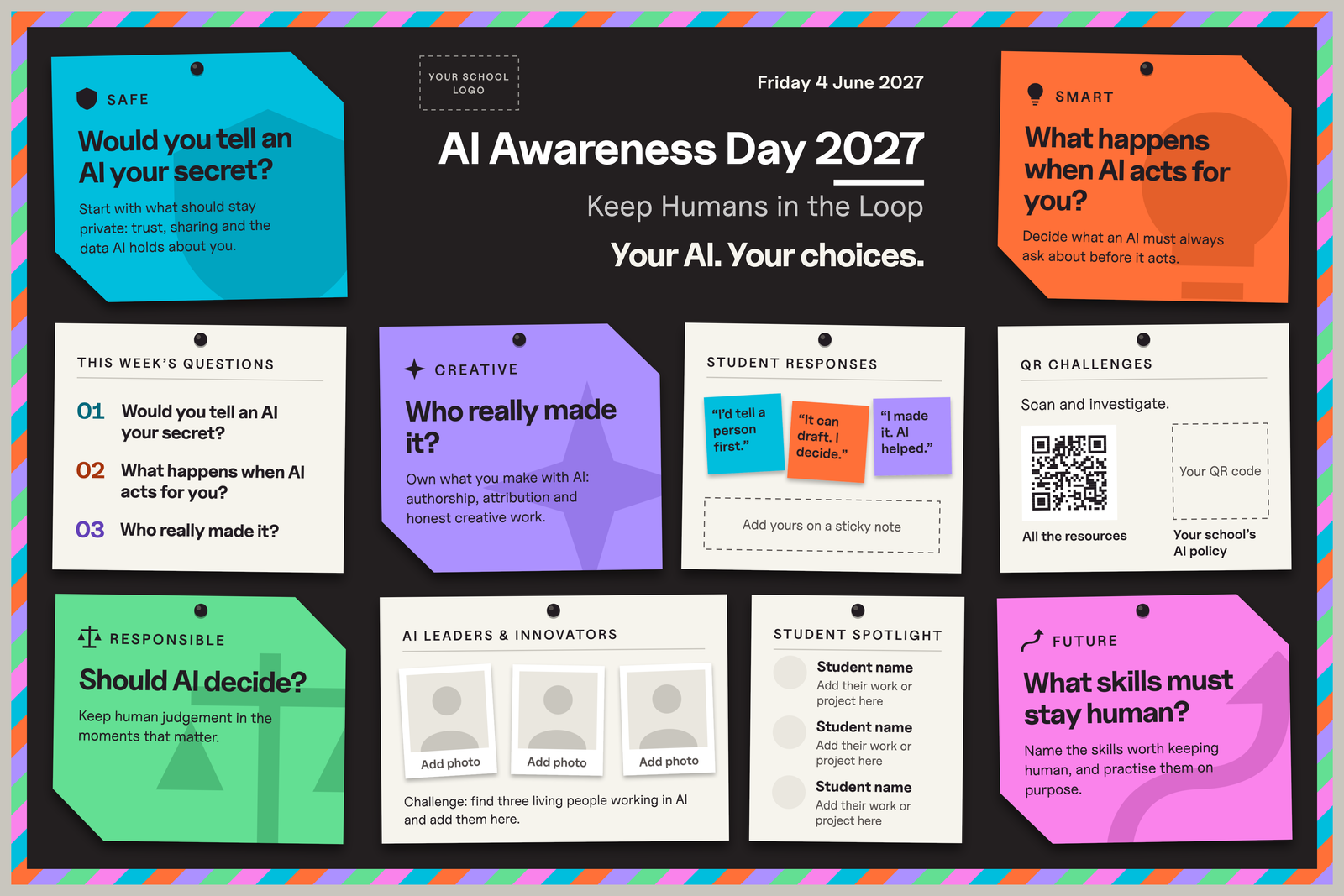
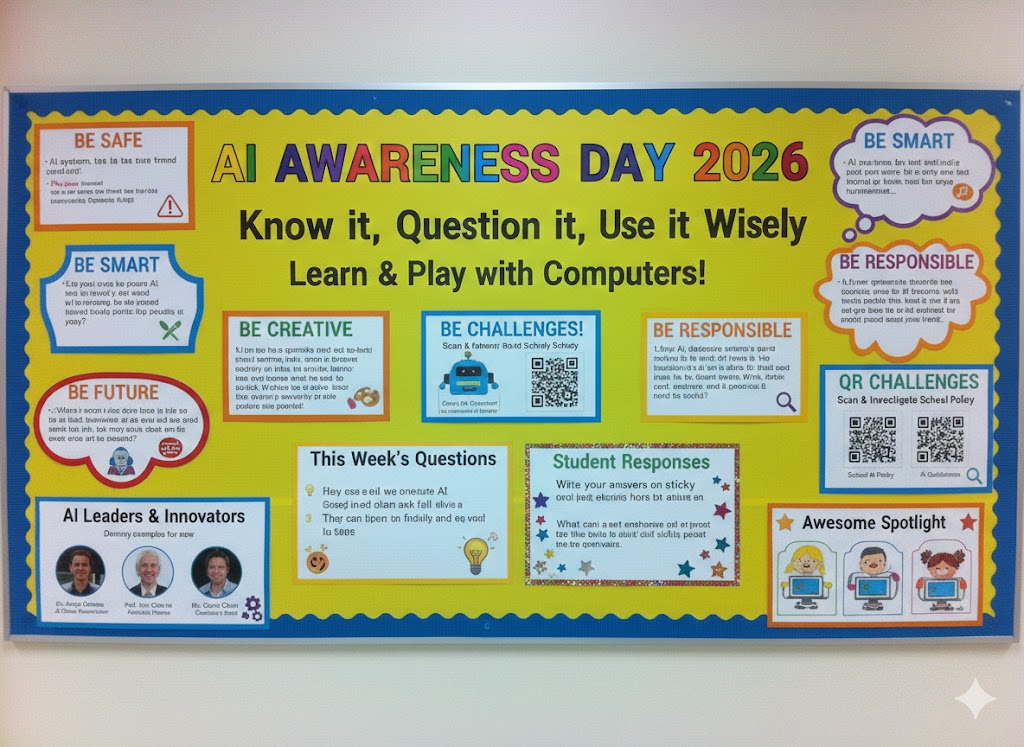
Create a display board for your school
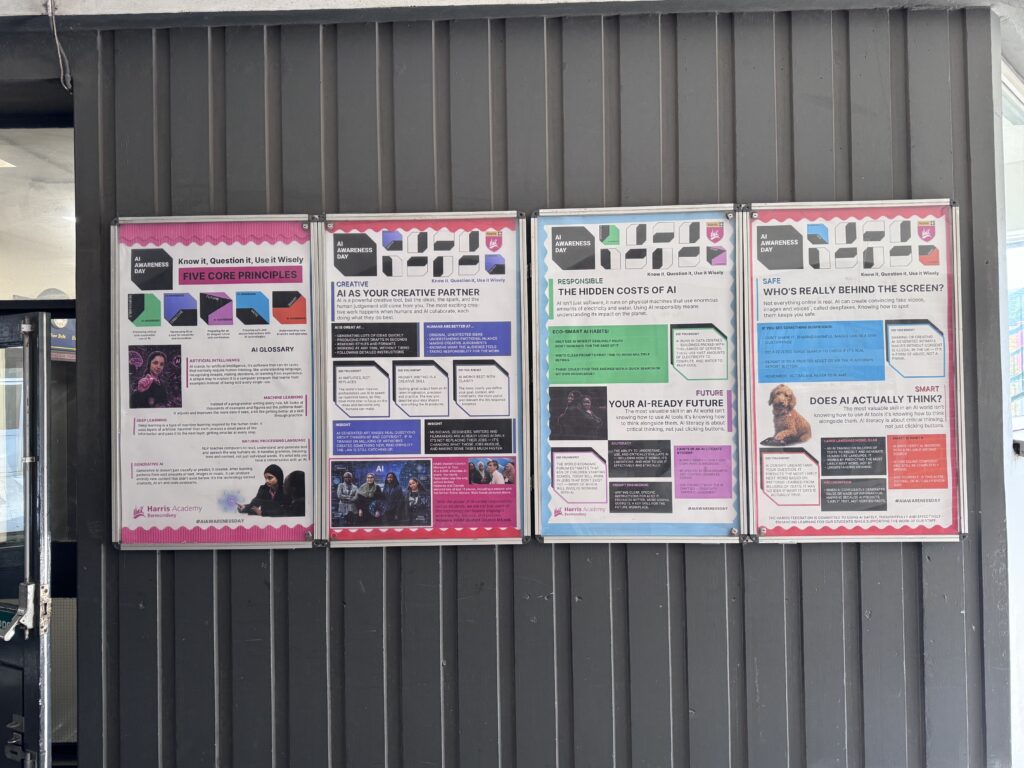
Use the layout below as a guide to build a physical display in your school or staff room.
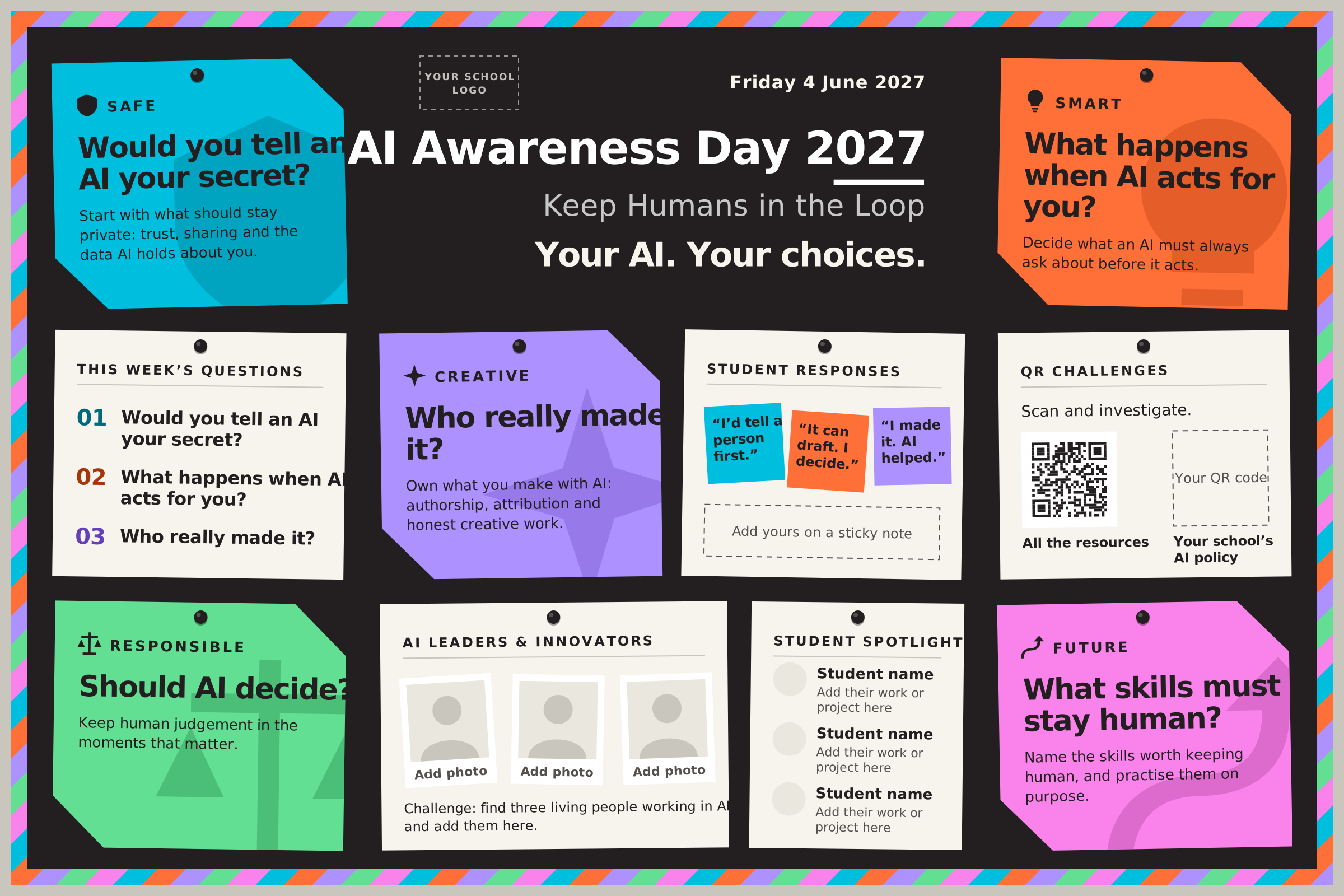
SAFE
Protect your privacy and personal data when using AI tools.
Did you know: AI systems can be biased if trained on biased data. Always question the source and verify information!
SMART
AI processes info faster than humans, but humans are better at creative problem-solving!
Did you know: ChatGPT was trained on 45TB of text data — that's equivalent to reading every book in a large library!
CREATIVE
AI can generate art and music, but the most creative works come from human-AI collaboration!
Did you know: AI can recognise patterns humans miss and generate creative solutions in seconds!
RESPONSIBLE
Every AI decision affects real people. We must consider the impact and use technology responsibly!
Did you know: AI can process information 1 million times faster than humans, but we must use it ethically!
FUTURE
By 2030, 85% of jobs will require AI skills. Start learning now to be future-ready!
Did you know: The AI industry is growing 40% each year — learning AI skills now prepares you for tomorrow's jobs!
QR CHALLENGES
Scan QR codes to discover your school's AI policies and guidelines!
This Week's Questions
- How can we ensure AI tools are fair?
- What are AI's strengths vs humans?
- How can AI enhance creativity?
Student Responses
"AI should be transparent"
"Humans understand emotions better"
"AI helps brainstorm, I add creativity"
Students write answers on sticky notes here
AI Leaders & Innovators
Add Photo
Add Photo
Add Photo
Add photos of AI leaders like Andrew Ng, Fei-Fei Li, Yann LeCun, etc. Set students the challenge: find 3 living people working in AI!
Student Spotlight
Student Name
Add student work or project here
Student Name
Add student work or project here
- Select a prominent wall, noticeboard, or display area in your school or staff room.
- Follow the blueprint layout: create five principle panels (Safe, Smart, Creative, Responsible, Future) each with a key message and practical tips.
- QR challenges: Set up QR codes for students to scan & investigate. Link to your school's AI policy and our AI guidelines or activities.
- Add interactive elements: Include facts, tips, or QR codes linking to games and quizzes using our interactive resources.
- This week's questions: Add thought-provoking questions like "How can we ensure AI tools are fair?" with space for student responses.
- Student responses: Provide space for sticky notes or written answers where students can share their thoughts and ideas.
- AI leaders & innovators: Include photos and names of people working in AI.
- Set them a challenge: Ask students to find 3 living people working in AI and add their discoveries to the display.
- Student spotlight: Feature student work or projects to showcase pupil achievements and creativity.
New · Free for UK schools
Audit your AI usage
Take the AI Risk & Readiness Benchmark™ — a free interactive audit to measure adoption, dependency and readiness across your whole school community.
Personalised for you
Discover the thematic areas that shape AI Awareness Day activities and discussions. Filter by theme or by session length.
By theme
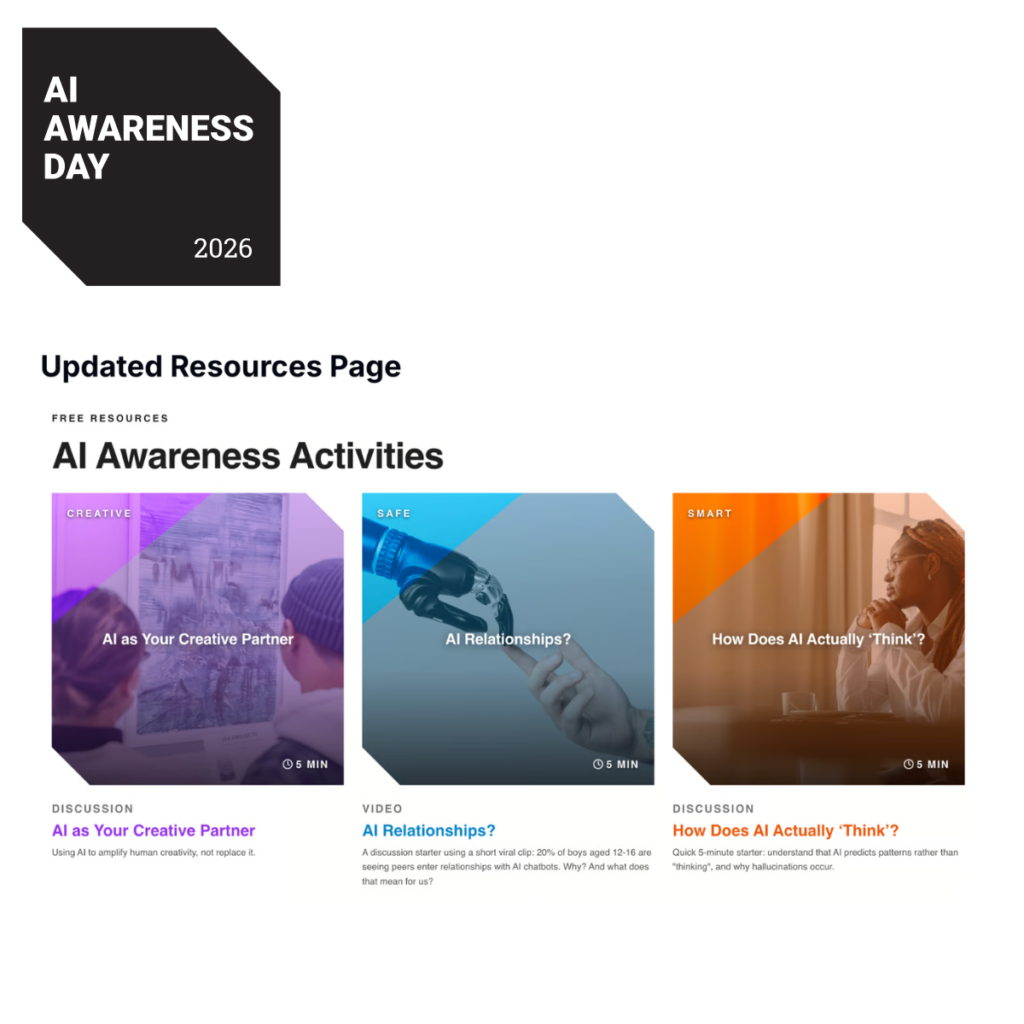
AI Awareness Activities
AI as Your Creative Partner
AI Relationships?
A discussion starter using a short viral clip: 20% of boys aged 12-16 are seeing peers enter relationships with AI chatbots. Why? And what does that mean for us?
How Does AI Actually ‘Think’?
Quick 5-minute starter: understand that AI predicts patterns rather than "thinking", and why hallucinations occur.
Handpicked Quality Resources
A curated selection of interactive AI games and learning tools from trusted organisations.
AI Quests
Hands-on AI quests and classroom-friendly challenges that walk students through data, models and real-world applications of AI.
Alexa Skill Blueprints
Create simple custom Alexa skills from templates — stories, quizzes and lists — without writing code, great for “how does Alexa work?” lessons.
Defend the Rhino with AI
An educational game where learners use data and machine learning to help rescue rhinos from poachers.
Start using AI in your classroom today
Our curated collection of trending AI tools designed to enhance your lessons.
Claude.ai
Lesson planning, differentiation, feedback
- Lesson planning assistance
- Differentiation strategies
- Student feedback generation
ChatGPT
Brainstorming, rubrics, simplifying texts
- Brainstorming sessions
- Rubric creation
- Text simplification
Perplexity AI
Research with citations, fact-checking
- Research with citations
- Fact-checking capabilities
- Source verification
Get Involved
Whether you're a teacher, school leader, parent, or organisation — we'd love to hear from you. Join the movement and help shape how the next generation engages with AI.